
All lives matter
The Henry Nowak tragedy is an indictment of the anti-racism dogma spread by the insidious Black Lives Matter movement

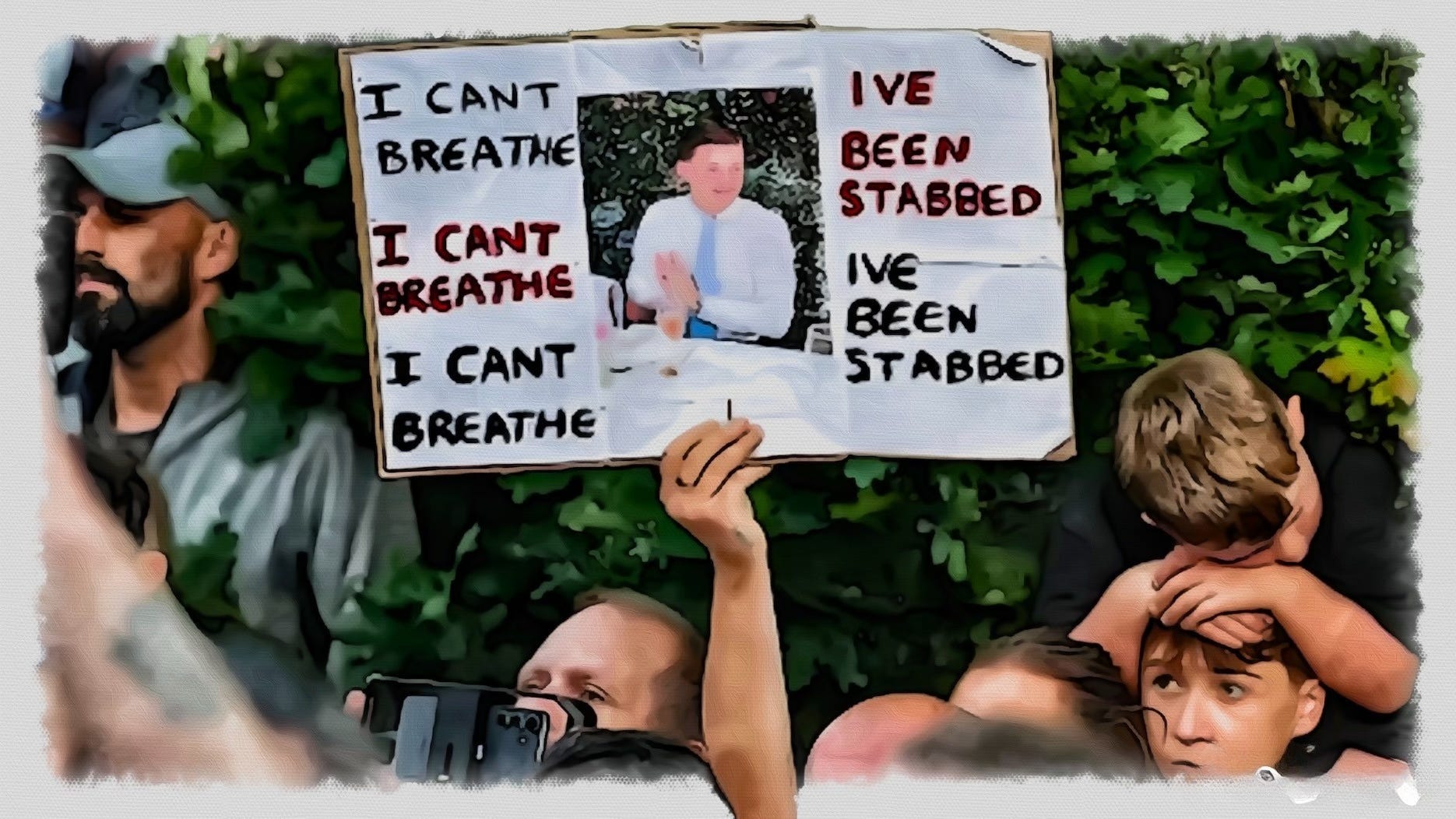
Policing is an untidy business. A first responder’s task of distinguishing the victim from the offender is not easy in the aftermath of an alleged altercation in a dimly lit street after closing time.
Yet police investigating the now notorious incident, which led to the death of an 18-year-old student in Southampton, UK, three weeks before Christmas, clearly overlooked some obvious clues.
One party was standing apparently unharmed save for the turban he claimed had been dislodged from his head. The other, Henry Nowak, was lying on the ground in his death throes, struggling for breath as he tried to convince officers he had been stabbed.
The police officers’ instinctive action was to handcuff and arrest the dying man before calling an ambulance as an afterthought. All the while, the man later confirmed to be his murderer and his brother stood there uncuffed, lying through their teeth.
The tragic death of Henry Novak serves as a parable for our time. It is an indictment of the dangerous doctrine of anti-racism, which entered the mainstream in 2020 with the death of George Floyd, who died from asphyxiation while under arrest by police in Minneapolis, Minnesota, USA, in May 2020. His death became a cause celebre, popularising the insidious slogan Black Lives Matter.
The anti-racism mind virus is now pervasive in elite institutions, not just in the US and the UK, but here in Australia. It contaminates our police forces and the broader justice system. It is dangerously entrenched in our universities, in public bodies like the Australian Human Rights Commission,
It has been adopted by the administrators of football codes and, naturally, our state-funded public broadcaster.
Yet far from serving to eliminate discrimination based on race, it has introduced a new form of racial prejudice no less uncivilised than the segregation laws that were once in place in the US, the White Australia policy or the Apartheid regime in South Africa.
In the West, including Australia, biological traits are no longer the least important thing one needs to know to judge a person’s character. They are the most important.
Thanks to the importation of the anti-racism doctrine, a generation is taught to believe that Australia is is riddled with systemic racism that offers privileges to white people and misery to everyone else.
The same is true in the UK, where police recruits arrive with a racially-essentialist world view that sees citizens not as individuals but as morally-laden categories.
The initial assessment made by the police officers who attended the crime scene near the corner of Belmont and St Denys Road in Portswood, Southampton, on December 3rd last year was not informed by observable facts. It was pre-determined by the nonsense theory embedded in their heads.
Confirmation bias and template thinking were enough to persuade them that Nowak, an 18-year-old white man, was the criminal and that Vickrum and Gurpreet Digwa, brothers of Indian Sikh heritage, were the victims.
Last week, Vickrum Digwa, 23, was jailed for life for murdering Nowak by stabbing him five times with a ceremonial Sikh knife. His brother awaits sentence on charges of being an accomplice.
The Nowak tragedy is a powerful indictment of the National Police Action Plan, adopted by the local Hampshire Constabulary four years ago, which abolished the notion of colour-blind law enforcement.
It changes a police constable’s job from an impartial keeper of the peace to an enforcer of the politically correct doctrine of reverse discrimination.
Combatting racism does not mean treating everyone ‘the same’ or being ‘colour blind’,” the policy states. “It is not enough for us not to be racist or to claim not to be racist. Anti-racism demands that we are proactive… it also requires us to remain vigilant, because racism is insidious.”
The new doctrine grants automatic victimhood status to people with dark skin, even those who are actual criminals.
White people, on the other hand, are assumed to be villains. They must be handcuffed and arrested, even if they are exhibiting signs of extreme physical distress and have no criminal history.
It is hard to find any empirical evidence to justify this underhanded form of racial profiling. Southampton City Council data says 70.5 per cent of offenders were white, roughly in line with the size of the white population, which was 68.1 per cent at the time of the 2021 census.
The contemporary doctrine of anti-racism was popularised Ibram X. Kendi, who claimed: “there is no neutrality in the racism struggle. The opposite of ‘racist’ isn’t ‘not racist’. It is ‘antiracist’.”
Kendi’s book, How to Be an Antiracist, became a New York Times bestseller in 2019, taking the new form of racism mainstream. The death of Floyd a year later turned Black Lives Matter into a global cause. The ritual of taking the knee was mindlessly enforced by sporting bodies.
Yet the eruption of spontaneous booing by fans, which began as early as December 2020 at a game between Millwall and Derby County, was a sign that the morality of Black Lives Matter was lost on ordinary people.
Until recently, the sacred obligation of police to provide impartial service to the law acted as a powerful institutional safeguard against human prejudice.
Hampshire Constabulary’s adoption of anti-racist language in 2022, in concert with other British police authorities, jumped the shark.
Police were charged with achieving social justice rather than legal justice, delivering equal outcomes rather than equal treatment.
It is futile to ask the question “could it happen here?” since we can see the woolly-minded logic of critical race theory embedded at every level of the Australian criminal justice system.
In 2025, NT Police became the first to launch an explicit Anti-Racism Strategy, making it a priority to “eliminate racism” mindful of “the impacts of disadvantage and intergenerational trauma.”
It pledges to interrogate data and intelligence for evidence of “systemic racism and over-policing” and “embed anti-racism principles into our decision making.”
Victoria Police came very close conceptually in its response to the Yoorrook Justice Commission, billed as Australia’s first formal truth-telling inquiry into “historic and ongoing systemic injustices perpetrated against First Peoples through colonisation”.
In May 2023, then Victorian police commissioner Shane Patten dutifully took the knee in a rhetorical sense to issue a formal and unreserved apology “for the police actions that have caused or contributed to the trauma experienced by so many Aboriginal families in Victoria.”
The damage done by turning criminals into victims is reported in the Herald-Sun almost every day. In Victoria, the chance of obtaining bail is only lightly correlated with the severity of the alleged offence. It is tightly correlated with youth and ethnicity.
The Australian Human Rights Commission’s National Anti-Racism Framework, launched in November 2024, prioritises racial justice over more traditional forms of justice.
Greens Senator Mehreen Faruqi, the one-trick pony of anti-racism, is demanding full funding and implementation of the National Anti-Racism Framework. Anti-racism and decolonisation have become pervasive themes for university administrations, embedded in numerous anti-racism strategies, codes of conduct and mandatory guidelines.
The ABC committed to “pro-actively anti-racist” in October 2024, beginning with a formal apology from the Managing Director to current and former staff “who have experienced racism while working at the ABC”.
It announced the appointment of a Director, First Nations Strategy, and that it would recruit a new Head of Diversity and Inclusion within\ the People and Culture department, renamed People, Culture and Inclusion.
So, while Australia has not uniformly adopted the Hampshire model, the intellectual infrastructure is in place.
It is why the story of Henry Novak must be heeded as a rallying cry to guard against the insidious infiltration of anti-racism, which dispenses with the principle that every human being deserves equal respect and therefore must be treated equally before the law.
Hampshire Police’s embrace of anti-racism goes beyond mere language. It reflects a broader transformation occurring across many Western institutions: a movement away from the classical liberal ideal of neutrality and towards a more activist conception of institutional responsibility. The extent to which that shift undermines the foundations of civilised society by weakening the rule of law may prove one of the defining political issues of the decade.
Indeed Nick. We all matter. Thank you for a sound article.
Welcome to anarcho-tyranny.
https://rafechampion.substack.com/p/britain-has-entered-the-age-of-anarcho
A healthy nation-state performs a handful of basic functions.
It controls the borders, enforces the rule of law, protects its own people from violence and disorder, and ensures that criminals who do break the law are punished.
But a nation-state that instead succumbs to anarcho-tyranny does the very opposite.
It becomes unable or even unwilling to perform its most basic tasks — controlling the borders, tackling petty crime, keeping people safe, and so on — while at the very same time becoming more intrusive, more bureaucratic, and more oppressive towards its own law-abiding citizens.