
Clueless and glueless
Superglue-wielding climate protestors need fossil fuels to survive as much as the rest of us

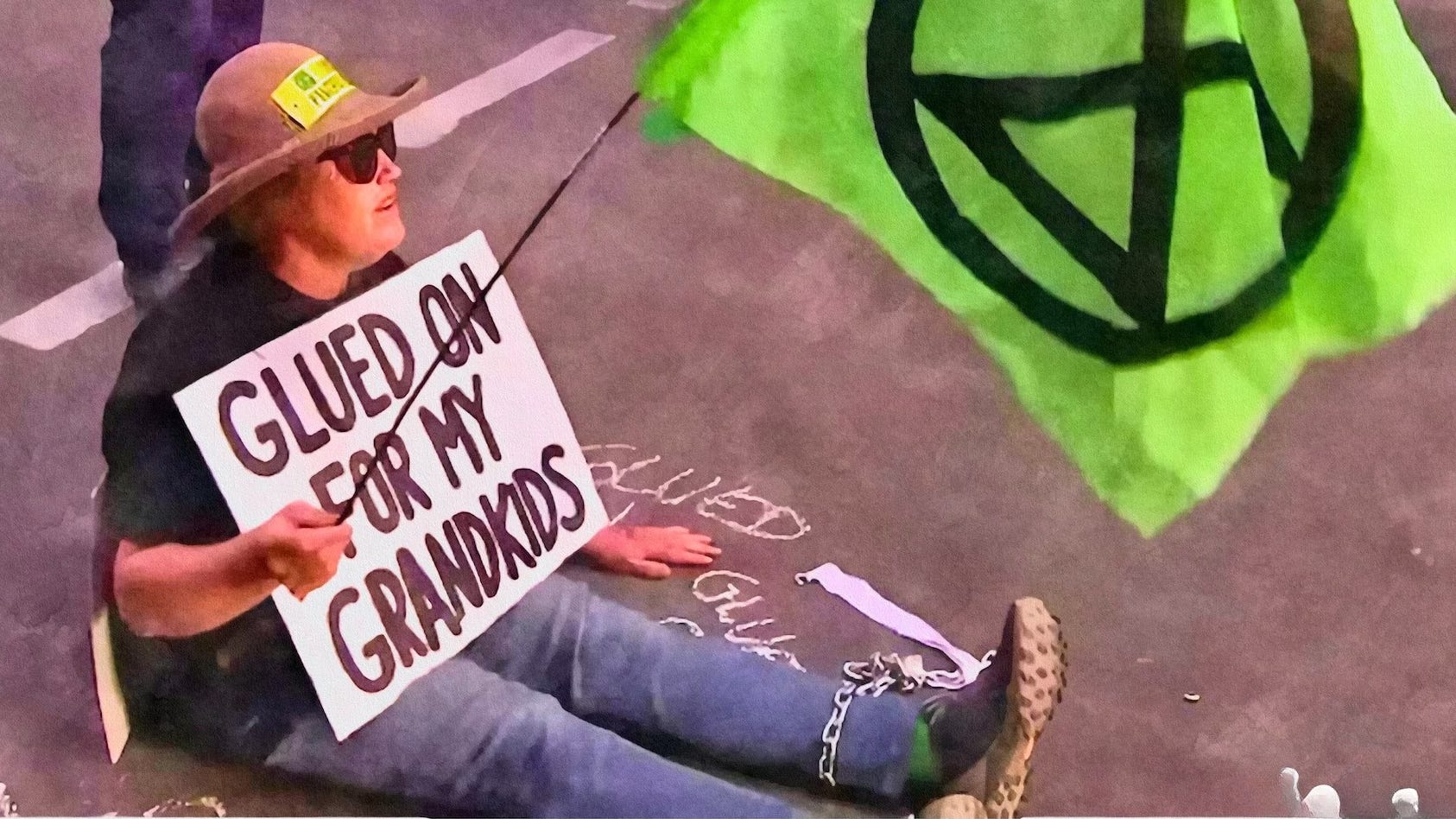
Two decades after Al Gore’s provocative movie An Inconvenient Truth propelled global warming into the mainstream, the Middle East oil shortage is a timely reality check on the indispensability of fossil fuels.
The raw numbers suggest the great energy transition has been a failure. In 2006, global CO2 emissions totaled 30.6 gigatonnes. In 2024, the most recent full year of data, they were 37.8 Gt, an increase of 20 percent.
This year, despite the fuel crisis, emissions will almost certainly hit a new record, as global energy demand shows no sign of abating.
In Australia, as in most of the world, attention has been fixed on the electricity grid. A gleeful Energy Minister pops up on social media at regular intervals to celebrate the installation of neighbourhood batteries, or some other expensive but inconsequential contribution to the great energy transition.
The Middle East fuel crisis should finally persuade us that net zero won’t be the walk in the park the signatories to the 2015 Paris Agreement seemed to think it would be.
The electricity grid is responsible for barely a third of greenhouse gas emissions.
Fossil fuels meet some 90 per cent of our energy needs, and for most uses there are few viable substitutes. As the supply of hydrocarbons dries up, the complex manufacturing chain that makes modern life comfortable begins to grind to a halt.
Take superglue, for example, an indispensable part of a performative climate activist’s toolkits used to bond themselves to the tarmac on busy city arteries.
Superglue is 90 per cent ethyl cyanoacrylate, a substance manufactured from petrochemical feedstocks derived from oil and natural gas.
As for the packaging, no one has yet found a way of wrapping superglue in hessian, hemp, or bamboo. High-density polyethylene tubes are the most practical solution, with a molded plastic cap added as a cherry on top.
Without single-use plastics, we’d be reduced to boiling collagen from animal hides like our ancestors, which may produce enough adhesive power to bind the pages of a book, but is hardly sufficient to stick a climate activist to the road.
Yet intellectual incuriousness, bounded thinking, and scientific illiteracy are the hallmarks of climate dogmatists.
They are inclined not to marvel at the human ingenuity and physical energy that have made the modern world an infinitely more comfortable and prosperous place to live than it was in the early 18th Century before the invention of the steam engine.
When Europeans first settled in Australia in 1788, global gross domestic product - a measure of the size of the economy - was around $US 1,500 a year, in 2021 terms, about the same as it had been 1000 years earlier.
In the last 300 years, the global average has risen to more than $US21,000.
In Australia, it’s more than $60,000.
The harnessing of coal, gas, oil, and uranium was the key to unlocking this growth. If the current fuel crisis continues, we will shortly watch this in reverse.
Already, supplies of industrial fertiliser and other farming inputs are diminishing. These energy-intensive products have doubled farmers’ output. Without them, food production will halve.
The contraction will affect almost every sector of the economy. This week, the building industry warned of a shortage of polyester pipes that will quickly put a stop to homebuilding if an inadequate supply of bricks, timber, and cement doesn’t do it sooner.
A diesel shortage will slow the flow of goods to the shops. Crops will go unharvested. Electricity production in remote areas and on islands that rely on diesel will be disrupted.
Spiraling inflation may well lead to the first serious recession in more than 30 years. Millennials and Gen Z might learn why their parents and grandparents blather on about the importance of fiscal management, productivity, and investment.
They will no doubt learn that living in a shrinking economy is to live in a world of shrinking horizons, where employment becomes uncertain, and opportunities are foreclosed.
Working families and small businesses in the suburbs have already been given a taste of what an energy-supply-induced recession will feel like. Petrol and diesel prices are eating into concessionary spending budgets. Meals out, taxi rides, and family excursions are becoming few.
By contrast, the economic slowdown is felt hardly at all in the comfortable eastern suburbs of our East Coast capital cities, or the western suburbs of Perth.
Fewer people have mortgages, and a higher proportion work in government-paid jobs, which will be the last sector to feel the pinch. More homes are owned outright, and a larger proportion live off wealth accumulated over more than three decades of largely unbroken growth.
It is in these suburbs that the false crisis of excess greenhouse gas emissions will linger longest. It will take some time for the penny to drop that the real emergency is not too much fossil fuel, but too little.
There is already a shortage of bricks in Western Australia. Welcome to the beginning of the recession.
Brought to us by a succession of Liberal and Labor governments! So over all the tiresome failed liberals and commentators on Sky sheeting all this home to Labor.