
Point of no return
The PM's evasion makes the return of female recruits to Islamic State deeply disturbing

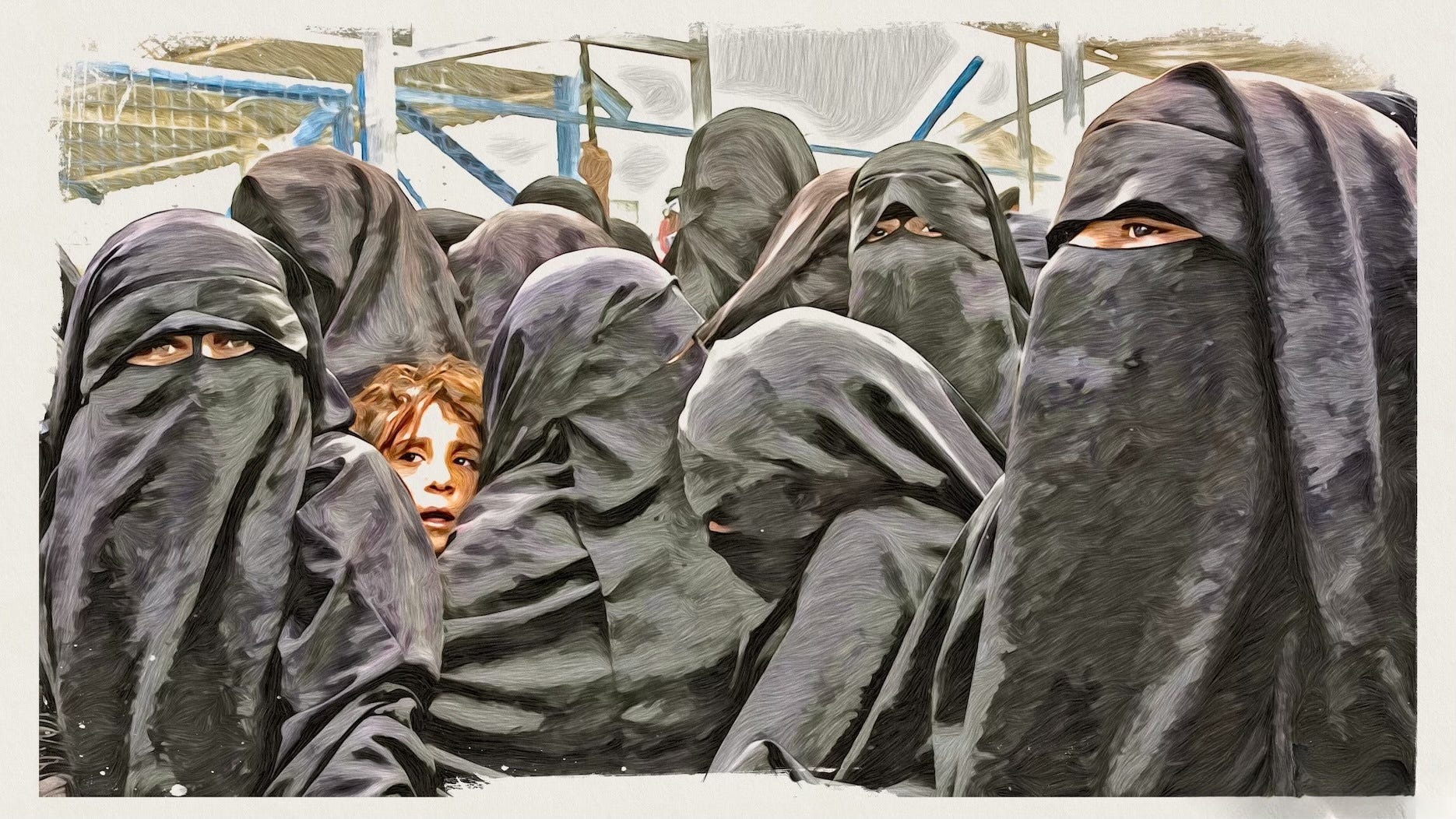
A grave threat to national security is in the hands of an evasive Prime Minister and a hopelessly conflicted Immigration Minister. We have every reason to be worried
The first duty of a government is to reassure Australians that the government is using every resource at its disposal to keep us safe.
Which is why the PM’s word games when asked about his government’s involvement in the return of radicalised Islamist women is more than a mere sleight to our intelligence. It is a sleight of hand, a subtle deception achieved by distraction.
On Thursday, the PM told ABC listeners: “The Government is providing no support for the repatriation of these people or any support whatsoever.”
Yet his immigration minister has confirmed that 11 ISIS-linked families in the al-Roj internment camp have been given passports. International conventions require that passports be issued by a competent government authority. Which makes the PM’s answer, to put it kindly, evasive.
Tony Burke stretches our credulity even further by telling us that passport issuance is an automatic process carried out by public servants.
Yet Burke has already demonstrated that the government is not powerless in this matter by revealing that one of the applicants had been banned from entering Australia by a temporary exclusion order.
Passport Office staff are now a law unto themselves. They are ultimately accountable to Foreign Affairs Minister Penny Wong, who has sweeping powers to cancel passports if she has “reasonable grounds” to suspect the passport would be used in a way that prejudices security.
The ISIS women are not the only ones to pass the “reasonable grounds” test. The PM’s cagey answers give us sufficient basis to question his government’s good faith. There are compelling reasons to doubt the Immigration Minister’s impartiality, given his other responsibility as the MP for a Western Sydney seat centred on Bankstown with a Muslim population of 25 per cent.
This week, the conflict of interest became too big to ignore with the discovery that Jamal Rifi, a prominent political supporter of Burke, is part of the group that travelled to Syria to smooth the families’ passage back.
As the Member for Watson, it is proper for Burke to listen to the concerns of his constituents and put them on the desk of the responsible minister. It is more than a little untidy; however, that minister happens to be him.
At the very least, Burke should delegate authority in these cases to Deputy Immigration Minister Matt Thistlethwaite.
As to the women themselves, we have reasonable grounds verging on absolute certainty to suspect that more than one of them presents a serious threat to the safety of Australian citizens were they to re-enter the country.
Indeed, it would be extraordinary if they did not, given the circumstances that drew them to Iraq and the radicalising environment in which they’ve lived for the best part of two decades.
That foreign recruits to ISIS housed in detention camps pose a substantial security risk is a matter for solid agreement among international authorities, even the woke ones.
The United Nations Security Council Counter Terrorism Executive Directorate (CTED) warns it is a mistake to portray them simply as “jihadi brides” who travelled to the conflict zone for romance and adventure.
It says the drivers of female radicalisation tend not to differ from those of men.
“If policymakers ignore the variety of women’s motivations in favour of stereotypes, this will limit the reach of any policy designed to counter or prevent their involvement in violent extremism,” it reported in 2019.[1]
We can safely assume the government is getting the same advice from its own security agencies. As Lydia Khalil wrote in a 2019 report for the Lowy Institute, the cohort of mostly female former caliphate members held in camps poses a key challenge for counterterrorism efforts around the world.
“Female Islamic State supporters have become vital players across the organisation, from birthing and indoctrinating the next generation of jihadists and maintaining networks and ties among IS supporters, to committing ultimate acts of violence in the name of their ideology,” she wrote.[2]
The international consensus is that the risk posed by each woman should be assessed individually, since motivation and degrees of complicity vary. Yet the reports also agree that establishing the facts is difficult, if not close to impossible. Attempts to prosecute returning jihadists in Europe and the United States have been hampered by the lack of evidence capable of standing up to scrutiny in court.
Which suggests that our government is acting naively, to put it kindly, in imposingexclusion orders on only one of these women. Particularly now that it has emerged that the Australian authorities have had little contact with any of them for more than three years.
Every one of them should be told they must wait until we’ve had a chance to get to the bottom of their stories and thoroughly check if they have any lingering allegiance to the evil cause they left our country to join.
These are not people who deserve the benefit of the doubt, nor do they have an automatic legal right to a new passport or to readmission to Australia.
As the PM said on Tuesday, these are “people who travelled overseas to participate in what was an attempt to establish a caliphate to undermine, destroy our way of life.”
If that is truly the PM’s assessment, we deserve to know who authorised these passports, on what advice, and under what safeguards. Until the government provides that, doubts will persist, not about the danger posed by ISIS, but whether those charged with protecting us are treating that danger with the seriousness it requires.
[1] UN report on women terrorists https://www.un.org/securitycouncil/ctc/sites/www.un.org.securitycouncil.ctc/files/files/documents/2021/Jan/feb_2019_cted_trends_report.pdfpage 11
[2] https://www.lowyinstitute.org/publications/behind-veil-women-jihad-after-caliphate
The issue of the ISIS brides is a current Liberal party talking point. As per normal, the party's messaging is sure to be influenced by tactical considerations as much as by more important principles. This is morally dangerous, because it centres on a just a handful of little people in trouble. No decent person would want to take advantage of them, making their lives harder, just for their own purposes. With a political party we cannot be so sure.
Mr Cater has pointed us to a UN report about women and extremist or terrorist organisations covering the present case. He extracts from this report that women have 'agency'. They did not join ISIS to fight but their motivations may go beyond, in the words of the report, 'romance and adventure'. It is a possibility that one or more of them might turn to domestic terrorism given the chance. They may, then again they may not. I mean, seriously, it is not exactly likely. It does not befit a decent Australian to say as Mr Cater does that they do not deserve the benefit of the doubt. (Who did he think he was, when he wrote that?)
Accepting that the UN report and another report from the Lowy Institute show that female recruits to ISIS can be highly motivated and could be dangerous, still there is use in our normal understanding of human psychology. ISIS is defeated. It failed in its ambitions. Those who committed to it must understand that they were mistaken. Since their return to normal life has been jeopardised we would expect them to experience gratitude when it is allowed. ISIS was not a domestic terror organisation of the Red Brigade or Weathermen type whose members operated in secret against their own societies. The recruits to ISIS acted openly. They hoped to be part of a movement setting up a new kind of society which seemed to be within reach. They were internationals. The new nation was to be far away in a land that they imagined more than they knew.
It is only supposition that after the failure of their hopes, and their return to safety of their homes they might turn to spiteful acts against their homeland, all the while being well-known to police and intelligence services.
Unfortunately the Liberal party is pushing this unlikely hypothesis as a political tactic. This is dishonourable. The Liberal party speaks of opponents of Israel terms as spreading hate. Victimising the ISIS brides is spreading hate and spite. While they do this, the Liberal party does not serve the support of the average Australian.
The subject matter of the UN report is understanding how women came to involved wit ISIS and how to deal with them as they return. Condemning them to exile is not considered. Importantly Mr Cater writes -
"Every one of them should be told they must wait until we’ve had a chance to get to the bottom of their stories and thoroughly check if they have any lingering allegiance to the evil cause they left our country to join."
It is important because here he concedes the point that the women are not to be exiled from Australia. Their normal right to live in Australia, their country of citizenship, is not to be arbitrarily abrogated. Not by the device, for instance, of opportunistically refusing to re-issue passports. (The report says they may have given up their passports to demonstrate their loyalty to ISIS.)
Mr Cater is a writer who supports the Liberal party line but of course has his own views at the same time. Importantly, and I hope this is true, he observes certain limits. He concedes that the women must be allowed to return with the condition that the ASIO or whoever investigates them. There is no difficulty here in resolving the two parts. Indeed it would be interesting, could be illuminating, if the women were not cooperative with investigators.
With this, the rest of Mr Cater's piece falls away into obscurity or irrelevance. It is if he wrote with the general idea of supporting the Liberal party line, but held back from writing what he knew was wrong. Whereas I do accuse the Liberal party of saying morally wrong things - did Angus Taylor not suggest changing the law so as to withhold passports? -conceding that there is not a legal basis to do so. Just as the statement of Mr Cater's that I have pointed out shows him to be essentially fair, I would say Mr Taylor's statement condemns Mr Taylor himself.
The ISIS brides are Australian citizens. They are our problem if they are troublesome but there is no reason to presume that they present any particular risk. There would have to be a proper reason given to believe otherwise. They are unlikely to have had the chance to do something terribly wrong even if they were capable of it and perhaps they can be thankful for that.
Of course we can deal with them as they return and that is the point of the UN report that Mr Cater has brought up.
Typo: Passport Office staff are now a law unto themselves - should read 'not a law'